


CASE STUDY : NIKE
Nike celebrates speed on the track.
But on the streets of London, speed isn’t a sport-it’s survival.
Here, movement is instinct.
A learned response to tube doors closing, buses disappearing, and a city that never waits.
Nike’s idea of speed-structured, perfected, celebrated meets something rawer in London: speed as adaptation. Speed as urban reflex.
And in that space between performance and necessity, a different kind of athlete emerges; one not chasing records, but simply trying to keep up.
The Premise
Nike is usually spoken about in the language of elite sport; records, medals, moments that look clean and absolute under stadium lights.
But that’s not where most movement lives.
It’s in the quiet discipline of a Tuesday morning in Zone 2, when it’s raining and the pavement is crowded and nobody is watching. It’s the walk to the station when you’re already running late. The climb of escalators that feel too long after a full day. The small decision to keep moving when it would be easier not to.
There’s nothing dramatic about it. That’s the point.
This project starts from a simple truth:
Londoners are already athletes.
They just don’t call it that.
The Objective
“Just Do It” doesn’t need to be louder. It needs to feel closer.
This project reinterprets the slogan through a raw, hyper-local cultural lens; through the reality of
The aim is to shift the idea of “Just Do It” away from sport as an exception - and toward Londoners as they are:
people who don’t pause, don’t wait for conditions to be perfect, and keep going because life in this city requires it.
Core Concept
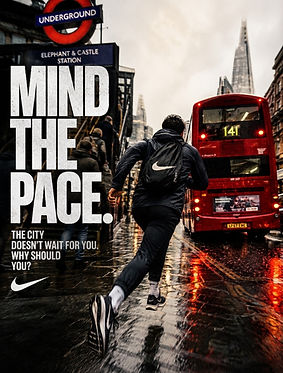
Mind the Pace
This isn’t about running as sport. It’s about running because the 141 is already pulling away.
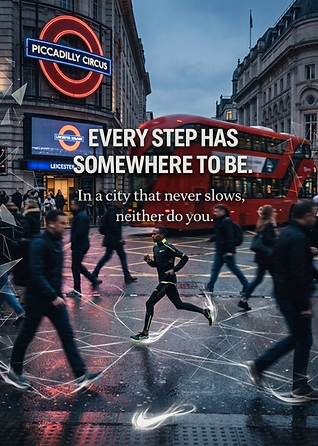
It’s the split-second decision at the kerb, the quick change of pace down a wet high street, the quiet calculation of whether you can still make it if you move now. No crowd, no countdown - just the everyday urgency of getting across London in time.
London moves in fragments. A bus, a gap in the traffic, a platform just about to close. People don’t think of it as training, but their bodies do. They speed up without noticing. They adjust their breathing between stations. They learn routes not just by maps, but by effort.
The platform isn’t a starting block. It’s just where you end up running from when you’re late again. The Oyster tap isn’t a signal to begin - it’s a small relief that you made it on time this time.
And in all of this, Nike doesn’t feel like performance wear for a race. It feels like what you put on when the city doesn’t slow down for you.
Not for marathon runners. For the ones trying to connect the ends.
Strategic Direction & Tone
This is a shift in how Nike is positioned - not as a symbol of elite performance, but as something closer to everyday endurance in motion.
From controlled athletic achievement
→ to the rhythm of navigating a city that never slows down.
Audience
People who don’t think of themselves as athletes, but move like them anyway.
-
Commuters moving through the city’s pressure points
-
Those who turn transfers, delays, and detours into part of their daily pace
-
People who are always slightly behind schedule, but still in motion
-
Londoners navigating distance not in miles, but in minutes and timing
This is not about running as sport.
It’s about movement as necessity.
And Nike becomes less about performance on display
and more about keeping up with a city that doesn’t pause for anyone.
Key Campaign Lines
-
Nike. Mind the Pace.
-
You don’t plan to run. You just do it.
-
London doesn’t ask if you’re ready. It just moves.
-
The city isn’t waiting. It’s already gone ahead.
-
The city doesn’t wait. Why should you?
-
Catch it if you can.
-
London in Motion.
Execution Lines
-
Nike. Mind the Pace. The doors close in four seconds.
-
Nike. Mind the Pace. Your training ground is the Northern Line.
-
Nike. Mind the Pace. Missing 7:42 is missing your morning.
-
Nike. Mind the Pace. Platform 4 is your track. The escalator is your hill climb.
Narrative Exploration
London does not walk.
It runs.
Not in the athletic sense, but in the way it structures life itself.
A blur of buses, rails, crossings, rain, and rushing bodies moving through shared urgency.
Eight million people perform daily choreography without rehearsal:
weaving through crowds, timing crossings, climbing stairs like intervals, racing doors like finish lines.
This is not fitness.
This is fluency in motion.
The city is not slowing down.
And neither are its people.
Personal Footnote
This concept emerges from observing London at its most honest state - its rush hours.
It reframes Nike not by elevating sport, but by grounding it in reality:
that athleticism is not only found in competition, but in the everyday endurance of navigating a city that never pauses.
“Just Do It” becomes less a slogan of ambition and more a reflection of instinctive urban survival.